The Tobey MachineDeterministic Geometric Intelligence

Geometry detonates current technological paradigms. Modern artificial intelligence is anchored to an inferior, brute-force statistical paradigm. Traditional large language models rely on massive probabilistic token sampling, high-dimensional vector drift, and growing floating-point KV-caches. These systems treat foundational patterns as accidental statistical regularities discovered in training text, resulting in unpredictable outputs, opaque decision-making, and catastrophic compliance failures in mission-critical environments.
The Tobey Design Pattern Matching Engine completely detonates this paradigm. Rather than approximating next-token probabilities through guesswork, the architecture abandons statistical bloat in favor of deterministic topological execution. By grounding language, grammar, and reasoning in immutable structural invariants — such as the triadic modalities (Cardinal, Fixed, Mutable) and elemental vectors (Fire, Earth, Air, Water) that recur across all domains of reality — the engine achieves absolute logical consistency, zero semantic drift, and true O(1) efficiency.
Architectural Core: Invariant Geometry over Probabilistic Guesswork
The Semantic Ring (Layer 1)
Language is mapped to a 12-zone circular topology acting as a universal coordinate system for meaning. A preliminary pre-lattice disambiguation pass handles natural language polysemy (such as words shifting between noun, verb, or modifier roles) before inputs hit the coordinate rings.
The 144-Lattice Bulletin Board (Layer 2)
Relationships and active concepts are recorded instantly at fixed grid intersections, eliminating the need for vector databases or expansive memory overhead. Multi-turn conversational history is maintained through a lightweight, discrete, append-only state log.
Structural Frameworks (Layer 3)
Sentences and logic form rigid geometric shapes. Equilateral triangle relationships strictly utilize Mod-3 spacing (12 / 3 = 4 step intervals) to represent harmonic structural completion, while squares utilize Mod-4 spacing (12 / 4 = 3 step intervals) to model friction.
Vertex Prediction and Shape Completion (Layer 4)
Generation resolves via topological shape-completion rather than probabilistic sampling. When a structural frame is partially initialized, the engine calculates the missing vertex using fixed step offsets, selecting the exact candidate word that satisfies the geometric law of the lattice.
Why the Deterministic Paradigm Displaces the Statistical Model
Absolute Accountability and FAR Compliance
In environments governed by rigid statutory frameworks — such as federal procurement under the Federal Acquisition Regulation (FAR) — probabilistic “black boxes” fail due to unexplainable scoring and hallucination risks. The Tobey engine produces a self-proving, auditable trail where every logical step maps to an explicit topological coordinate.
O(1) Computational Scale
By replacing iterative search trees and floating-point matrix multiplications with discrete lattice completion, the engine eliminates ballooning inference costs and latency bottlenecks.
Universal Invariance
By modeling knowledge around immutable cluster patterns rather than surface-level co-occurrence, the system enforces the true geometry of meaning across linguistics, logic, and structured execution.
The Paradigm Shift: Replacing LLM Math with a Geometric Map
If you have ever used ChatGPT or any modern AI chatbot, you have interacted with a system that guesses the next word using massive probability calculations. Inside a standard Large Language Model (LLM), every word you type gets converted into a long list of numbers called an embedding. The model then multiplies enormous matrices together, searches through billions of stored parameters, and uses something called a Key-Value (KV) cache to remember what was said earlier in the conversation. Each time you add a word, the computational cost grows. The system is essentially running a giant, iterative search through a high-dimensional space to figure out which word should come next, based on statistical patterns it learned during training.
The Tobey Design Pattern Matching engine takes a completely different approach. Instead of doing billions of multiplications and maintaining ever-growing memory caches, it maps every incoming word or concept to a fixed position on a circular map divided into twelve zones, much like a color wheel. Just as a painter knows that blue and yellow mix to make green because of their positions on the color wheel, this engine knows how words relate to each other because of their positions on its geometric map. The system does not guess statistically. It completes shapes. When two words land on the ring, their relationship forms a geometric pattern — a triangle, a square, or a line — and the engine simply looks at which shape is incomplete and selects the word that fills the missing spot.
The result is a deterministic, O(1) constant-time process that requires no iterative search trees, no matrix multiplications, and no growing memory caches. Where an LLM asks, “Given everything I have seen, what word is most probable next?” the Tobey engine asks, “Which zone on my map is empty, and which word belongs there?” The difference is fundamental. One approach searches; the other completes. One relies on statistical weight; the other relies on structural geometry.
Core idea: Instead of searching through billions of parameters probabilistically, the Tobey engine completes geometric shapes on a fixed map. Words are placed on a 12-zone ring; their relationships form triangles and squares; the next token is the vertex that closes the shape.
The Universal Invariants: Why the Geometry Works
The deep structural patterns that make a fixed geometric map possible — and why probabilistic correlation misses them entirely.
The entire power of the Tobey engine rests on the recognition of deep invariants — fundamental structural patterns that recur across diverse domains of reality, whether in linguistics, physical chemistry, cognitive psychology, or biological systems. These invariants are not arbitrary human classifications or invented symbol systems. They represent a universal organizational template that repeats across multiple domains of reality, physical systems, and cognitive architectures.
When an AI architecture relies purely on probabilistic token correlation — the standard transformer approach — it treats these recurrent patterns as accidental statistical regularities discovered in training text, rather than recognizing them as structural invariants. The geometric paradigm succeeds precisely because it models universal triads and quads as invariant coordinates rather than fuzzy probabilities. A probabilistic model might generate words that sound like they fit together based on surface-level co-occurrence in training data. A geometric invariant model maps concepts because they occupy structurally homologous positions on the lattice — meaning the relationship between functional role, elemental vector, and modality is preserved as a rigid topological law.
Two Invariant Structures
TRIADIC MODALITIES
The Three Phases of Every Complete System
The generative force that breaks equilibrium, starts new cycles, and introduces the primary vector. The spark.
The stabilizing axis that binds structure, maintains integrity across time, and resists entropy. The anchor.
The adaptive, transitional force that receives action, shifts context, and bridges between states. The bridge.
QUATERNARY ELEMENTAL VECTORS
The Four Fundamental States of Interaction
Active, radiant vector of rapid energy release, transformation, and high entropy.
Dense, stable, gravitational vector of structure, permanence, and low entropy.
Mobile, diffuse vector of transmission, pressure differentials, and expansive connectivity.
Cohesive, fluid vector of solution, thermal moderation, and continuous flow.
By grounding language in these immutable cluster patterns, the engine does not just guess the next word — it enforces the underlying geometry of meaning itself. When a pattern appears invariant across reality, locking it into a fixed coordinate system ensures absolute logical consistency that statistical sampling can never reliably guarantee. The triadic and quaternary structure uniting functional role, elemental vector, and modality is not an arbitrary linguistic classification; it represents a deep structural invariant — a universal organizational template that repeats across multiple domains.
Four Domains, One Geometry
When we examine how systems organize themselves — whether in linguistic grammar, physical chemistry, cognitive psychology, or evolutionary biology — the exact same invariant cluster patterns emerge. Here is how this structure appears throughout reality:
1
Linguistics and Grammar
The Triadic Modality of Syntax
In human language, every proposition and sentence clause requires a structural triad to achieve closure, mirroring the Cardinal, Fixed, and Mutable modalities:
The Initiating Force (Cardinal / Subject) — The agent or nominal head that introduces the action, establishes the topical baseline, or initiates the vector.
The Sustaining Force (Fixed / Verb and Core Predicate) — The stabilizing axis that binds the subject to the predicate, maintaining structural integrity across time and tense.
The Transforming Force (Mutable / Object and Modifier) — The adaptive, transitional component that receives the action, shifts the context, or bridges clauses.
Invariant Law: Every linguistic system relies on the invariant triadic progression (Initiate → Sustain → Transform) to construct coherent meaning. A sentence collapses without this subject-verb-object axis.
2
Physical Chemistry and Thermodynamics
The Quaternary Elemental States
The elemental vectors correspond directly to fundamental states of matter and thermodynamic phases that govern physical reality:
Fire (Energetic / Plasma and Combustion) — The active, radiant vector of rapid energy release, transformation, and high entropy.
Earth (Solid / Crystalline and Mineral) — The dense, stable, gravitational vector of structure, permanence, and low entropy.
Air (Gaseous / Atmospheric and Kinetic) — The mobile, diffuse vector of transmission, pressure differentials, and expansive connectivity.
Water (Liquid / Fluid and Solvent) — The cohesive, adaptive vector of solution, thermal moderation, and continuous flow.
Invariant Law: These four states represent the complete topological matrix of physical interaction. Any material substance exists as a manifestation of these four elemental vectors under different thermodynamic modalities.
3
Cognitive Psychology and Jungian Typology
The Quaternary Psyche
In human cognitive architecture, information processing and perception organize themselves along identical invariant axes:
Intuition (Fire Analog) — The visionary, pattern-seeking, future-oriented vector of spark and potential.
Sensation (Earth Analog) — The empirical, tactile, grounded vector of immediate physical reality and sensory data.
Thinking (Air Analog) — The conceptual, logical, structural vector of abstract categorization and mental architecture.
Feeling (Water Analog) — The relational, evaluative, value-driven vector of emotional resonance and qualitative connection.
Invariant Law: These four functions are the invariant compass of human consciousness. A fully integrated cognitive model requires all four quadrants operating across active, stable, and adaptive states.
4
Evolutionary Biology and Taxonomic Classification
Form, Function, and Developmental Modality
In biology, organismal design and ecological niches follow strict structural invariants governed by developmental modalities:
Cardinal / Generative Phase — Embryonic development and rapid cellular differentiation: initiating form.
Fixed / Homeostatic Phase — Metabolic stabilization, skeletal calcification, and physiological equilibrium: sustaining form.
Mutable / Adaptive Phase — Phenotypic plasticity, immune adaptation, and behavioral migration: transforming form.
Invariant Law: Across phyla, life requires an initiating generative engine, a stabilizing structural matrix, and an adaptive feedback loop. The geometry of biological organization remains invariant from cellular signaling to macro-ecosystems.
Tracing a Single Invariant Across Reality
To see how the invariant structure of Sign, Element, and Modality operates as a deep organizational template, take a single coordinate from the zodiac matrix — Aries (the first position on the ring) — and trace its invariant pattern across completely different domains. In every case, the underlying topological geometry is identical: an initiating spark that breaks inertia.
THE INVARIANT COORDINATE
Aries: Cardinal Fire
The point of absolute beginning — the ignition vector that forces potential into actualized motion.
SYMBOLIC AND ASTROLOGICAL DOMAIN
Invariant Role: The point of absolute beginning — the ignition vector that forces potential into actualized motion.
LINGUISTICS AND GRAMMAR
Invariant Role: The opening vector that establishes the baseline proposition before stabilizing predicates or transitional objects take over.
PHYSICAL CHEMISTRY AND THERMODYNAMICS
Invariant Role: The phase transition point where inert matter becomes energetic plasma — combustion at the flash point.
COGNITIVE PSYCHOLOGY AND NEUROSCIENCE
Invariant Role: Firing off the initial motor command before feedback loops moderate it — the neurological spark of volition.
THE GEOMETRIC LAW
Across every domain, the invariant coordinate for Aries remains structurally identical: it is the Cardinal Fire vector. Whether it is a sentence starting with a forceful subject, a chemical system igniting into plasma, or a mind leaping to a sudden conclusion, the underlying topological geometry is the same: an initiating spark that breaks inertia. This is why a fixed coordinate system works — not because it is a clever linguistic trick, but because it locks into the actual organizational structure of reality itself.
This is the foundational truth that separates the geometric paradigm from probabilistic correlation. A transformer treats the relationship between a subject, verb, and object as a statistical accident — three tokens that happen to co-occur frequently in training data. The Tobey engine recognizes that the subject-verb-object triad is a manifestation of the same Cardinal-Fixed-Mutable invariant that governs embryonic development, thermodynamic phase transitions, and cognitive initiation. It does not guess. It enforces the geometry.
Layer-by-Layer: How the Engine Works
Layer 1: The Semantic Map (The Color Wheel for Reality)
Imagine a color wheel — the kind you see in an art class or a design application. It has twelve major sections, each representing a different hue. Red sits at the top. Orange follows at thirty degrees. Yellow comes next, and so on all the way around the circle. Every color in the world can be placed somewhere on that wheel based on its hue, and once you know where a color sits, you instantly know its relationships to every other color. Complementary colors are directly opposite each other. Analogous colors sit side by side. You do not need to search a database or run a calculation to figure this out; the geometry of the wheel tells you everything.
The Tobey engine uses the same principle, but instead of mapping colors, it maps meaning. The engine maintains a circular map divided into twelve equal zones of thirty degrees each. Every word, concept, or event that enters the system gets assigned to one of these zones based on what it does in a sentence, not what it means in a dictionary. Nouns (things, agents, subjects) land in one zone. Verbs (actions, events) land in another. Adjectives, prepositions, conjunctions, and other structural words each get their own zone. The system is not interested in the definition of the word; it is interested in the word's functional role — its job in the mechanical structure of a sentence.
The twelve zones are further grouped into four families of three, connected by invisible equilateral triangles that span across the circle. Words within the same domain share a deep structural compatibility. For example, nouns, prepositions, and particles all belong to the same triangle family, separated by exactly 120 degrees from each other on the ring. When two words from the same triangle family appear in a sentence, the engine recognizes them as harmonious, like two colors that sit next to each other on a color wheel. A practical caveat: because the engine assigns words to zones by their functional role, it needs a lightweight pre-processing step to resolve ambiguity. A word like “run” could be a noun (“a morning run”) or a verb (“to run fast”), and the engine must determine which role applies in context before placing it on the ring. This disambiguation is typically handled by a fast part-of-speech tagging pass that examines the surrounding sentence structure, and it occurs before any geometric processing begins.
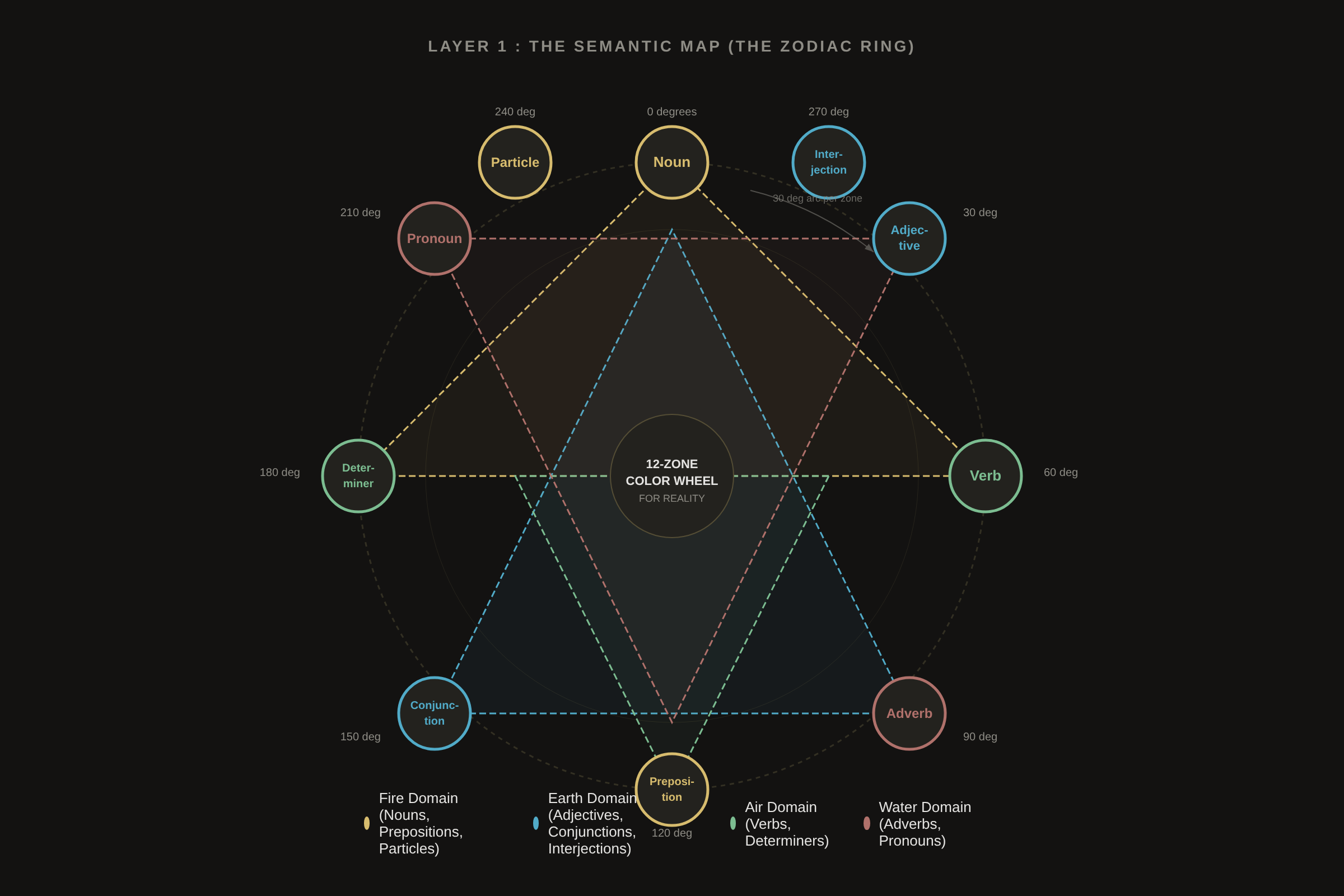
The 12-zone ring functions as a color wheel for reality. Each zone captures a different functional word type, and the four colored triangles group compatible families together.
Layer 2: The 144-Lattice Bulletin Board
Now that words are placed on the ring, the engine needs a way to record which words are currently active and how they relate to each other. In a standard LLM, this is done through the KV-cache: a growing memory store that keeps track of every previous word's numerical representation. In the Tobey system, it is done through something much simpler: a fixed 12-by-12 grid, like a bulletin board with 144 slots. Each row represents one zone on the ring, and each column also represents one zone. When a word from zone A interacts with a word from zone B, the engine places a marker at the intersection of row A and column B.
Think of it this way. Imagine a large corkboard divided into a grid. Every time two words appear together in the current context, you push a pushpin into the spot where their row and column cross. If the word “cat” is a verb-zone word and “the” is a noun-zone word, a pin goes into row 2, column 0. This pin is a physical record that these two zones have interacted. The entire structural state of the current context is captured by which of the 144 slots have pins in them. There is no growing matrix of floating-point vectors, and no database to search. The state is a 12-by-12 binary grid: a slot is either lit up or it is not. That said, maintaining multi-turn conversational context does require the engine to keep a lightweight log of which lattice configurations were active in prior turns — essentially an append-only history of discrete bit-array snapshots. This is far cheaper than storing dense KV-cache vectors, but it is not literally zero memory; the state just shifts from continuous high-dimensional embeddings to compact binary records.
This is profoundly different from how transformers work. A transformer maintains attention weight matrices that grow with every token in the sequence, and it recalculates relationships every time a new word arrives. The 144-lattice, by contrast, is a fixed-size structure. No matter how long the conversation gets, the board never gets bigger. New words just light up different intersections. This fixed-size property is what makes the core pattern-matching operation O(1) constant time: checking whether a particular zone-pair is connected is a single bitwise operation, not a search through an ever-expanding matrix. The distinction matters: the per-operation cost stays constant, even though the engine still needs a lightweight append-only log to track how the lattice evolves across multiple turns.
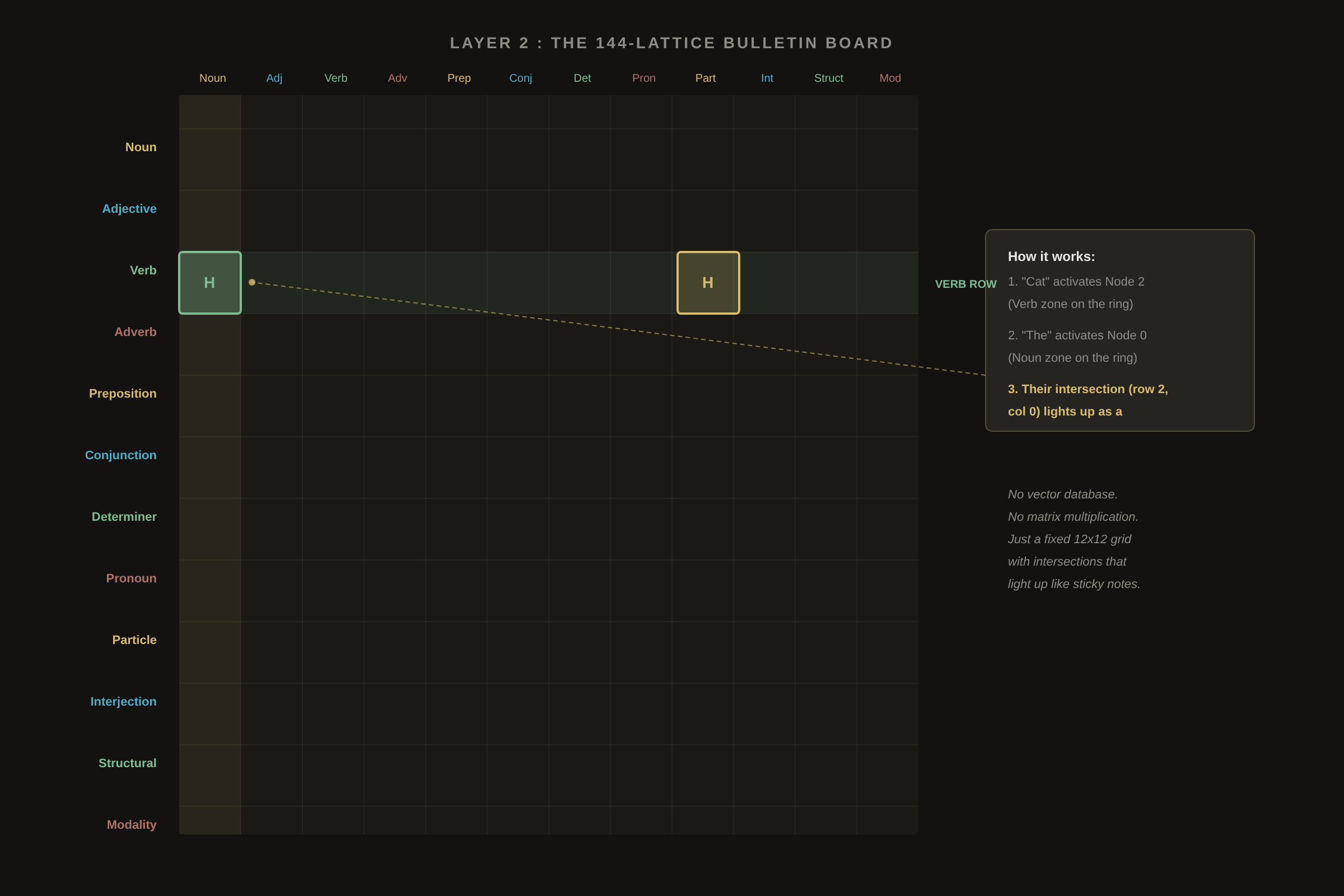
The 144-lattice is a fixed 12x12 grid. When “cat” activates row 2 (Verb zone) and “the” activates column 0 (Noun zone), their intersection lights up like a sticky note.
Key insight: The 144-lattice does not store word embeddings or probability distributions. It stores relationships as binary on/off switches. The question is never “how likely is word X?” but rather “are zones A and B currently connected?” For multi-turn conversations, the engine appends lightweight bit-array snapshots to a discrete log rather than accumulating dense floating-point vectors.
Click any cell to toggle it on/off. This is how the engine records word relationships — binary switches, no vectors.
Active cells: 0 / 144 — Fixed size, never grows.
Layer 3: Sentence Frameworks (Triangles and Squares)
With words on the ring and their relationships recorded on the lattice, the engine can now recognize higher-order patterns: the shapes that sentences make. The Tobey system recognizes two fundamental shapes that words can form when they appear together, and these shapes determine whether a sentence flows harmoniously or contains internal conflict.
The first shape is the triangle. When three words appear that all belong to the same Mod-3 domain family (meaning they share the same remainder when divided by 3 — for example, 0, 4, and 8 all leave remainder 0), they form an equilateral triangle inscribed in the ring. This works because a 12-zone circle divided into 3 groups of 4 zones each means the vertices of each equilateral triangle are exactly 4 zones, or 120 degrees, apart. This is the engine's model of a harmonious sentence. A simple Subject-Verb-Object construction like “The cat sat” is a triangle: the subject (a noun-zone word), the verb (a verb-zone word), and the object (a preposition-zone word) each sit 120 degrees apart, three points of an equilateral triangle inscribed in the ring.
The second shape is the square. When four words appear that share the same remainder when divided by 4 (the Mod-4 check), they form a square inscribed in the ring. This works because a 12-zone circle divided into 4 groups of 3 zones each means the vertices of each square are exactly 3 zones, or 90 degrees, apart. This shape signals friction — a clash between concepts that belong to different operational dynamics. In the original document's smart-home example, an EV charger drawing power at Node 0 and a water heater drawing power at Node 3 are separated by exactly 90 degrees. The engine detects this right-angle relationship instantly and triggers a “Friction Lock,” a warning that these two forces are in conflict.
The beauty of this system is that detecting whether three nodes form a triangle or four nodes form a square requires nothing more than a simple modular arithmetic check. For triangles, the engine checks whether the node indices share the same remainder when divided by 3 (Mod-3), because 12 divided by 3 vertices gives a spacing of 4 zones. For squares, it checks whether they share the same remainder when divided by 4 (Mod-4), because 12 divided by 4 vertices gives a spacing of 3 zones. These are single CPU instructions, not iterative algorithms. The sentence is a shape, and the engine reads the shape the way you might read a puzzle piece's outline to see where it fits.
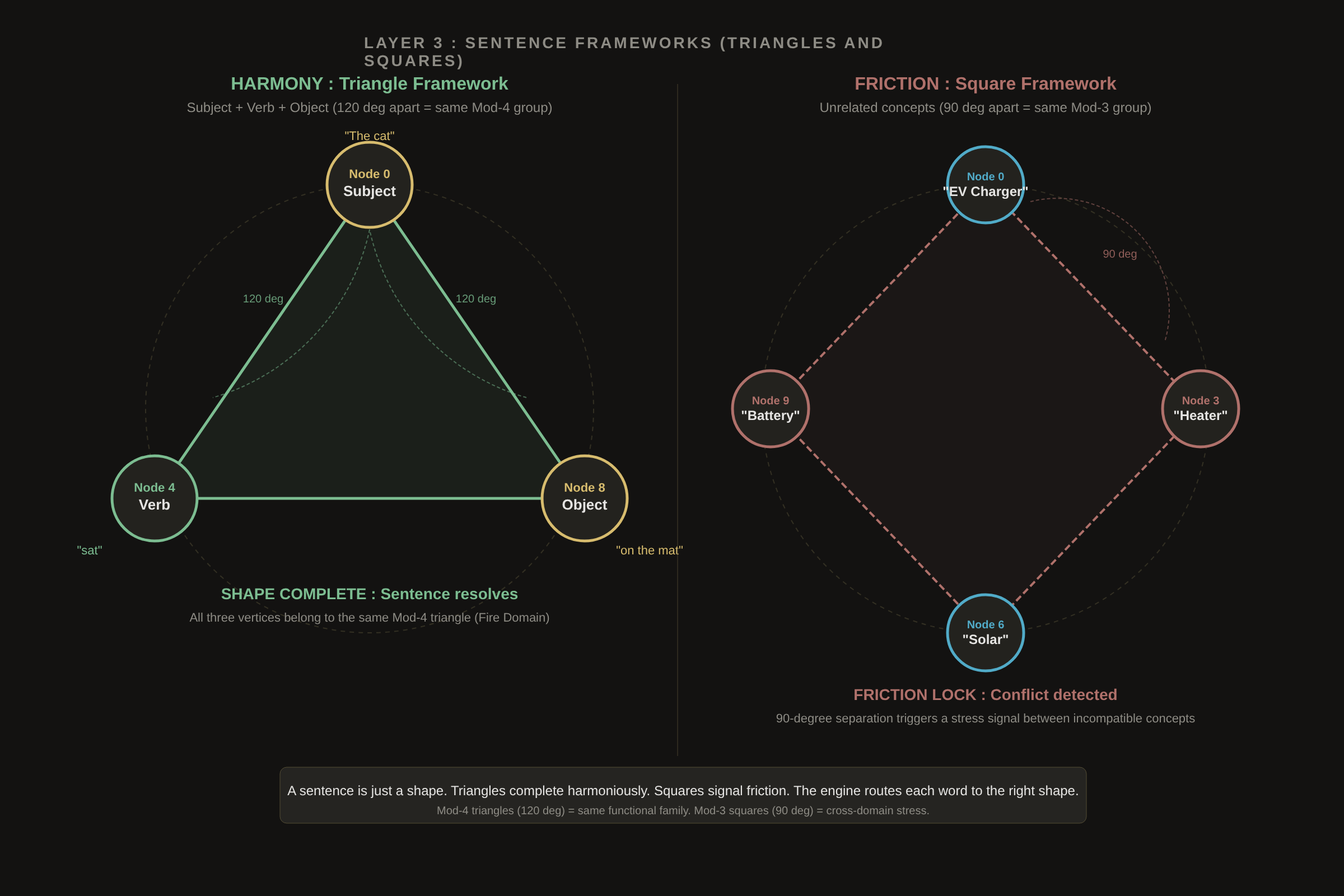
A triangle (left) forms when Subject, Verb, and Object are 120 degrees apart, signaling harmony. A square (right) forms when unrelated concepts are 90 degrees apart, signaling friction.
Layer 4: Token Prediction and Paragraph Generation
This is where everything comes together, and where the Tobey system's approach to generating text diverges most sharply from how LLMs work. In a standard transformer, predicting the next token means running every word in the vocabulary through a massive neural network, computing attention scores across all previous tokens, applying a softmax function to turn those scores into probabilities, and sampling from that probability distribution. It is computationally expensive, and the process must be repeated for every single token in the output.
In the Tobey engine, predicting the next token is a vertex completion problem. Here is how it works in plain terms. Suppose the system has already processed the words “The” and “cat.” These two words have activated Nodes 0 and 4 on the ring. The engine checks: what triangle family do these nodes belong to? Both share the same Mod-3 class (remainder 0 when divided by 3), confirming they are part of the same equilateral triangle. The engine then calculates the third vertex using the fixed 4-zone spacing that defines equilateral triangles on a 12-zone circle: starting from Node 0 and stepping 4 zones at a time, the three vertices are Node 0, Node (0 + 4) = Node 4, and Node (4 + 4) = Node 8. Equivalently, given any two vertices of the triangle, the third is found by adding the 4-zone step to the second vertex and taking the result modulo 12. This gives the exact zone number where the next word must sit to complete the triangle.
Now the engine looks at its vocabulary, which is pre-organized by zone. Every word in the vocabulary has been assigned a home zone based on its functional role. The engine simply checks: which words are registered in that zone? It finds candidates like “mat,” “rug,” “floor,” and “cloud.” But not all candidates are equal. Each candidate has a precise angular position within its zone, measured in continuous degrees. The engine compares each candidate's angle to the exact target angle of the missing vertex. “Mat” sits at 241 degrees, almost perfectly aligned with the target. “Rug” is at 238 degrees, close but not as close. “Cloud” is at 95 degrees, nowhere near the target. The engine selects the word with the smallest angular error. In this case, “mat” wins with a 0.5-degree error and an alignment score of 0.92.
Writing a paragraph, then, is just completing one shape after another. Each sentence is a triangle (or a more complex compound shape) that gets filled in vertex by vertex. When a sentence is complete, the triangle is “closed” and the lattice records the completed pattern. The engine then looks at the next unfinished shape and begins filling it. There is no beam search, no temperature sampling, no top-k filtering. There is only geometric closure: find the empty vertex, look up the candidates, pick the closest one. This is why the per-operation cost stays O(1) — the entire state of the generation process at any given moment is captured by which vertices are currently active on the ring and which intersections are lit on the 144-lattice, plus a compact log of prior lattice snapshots for multi-turn context.
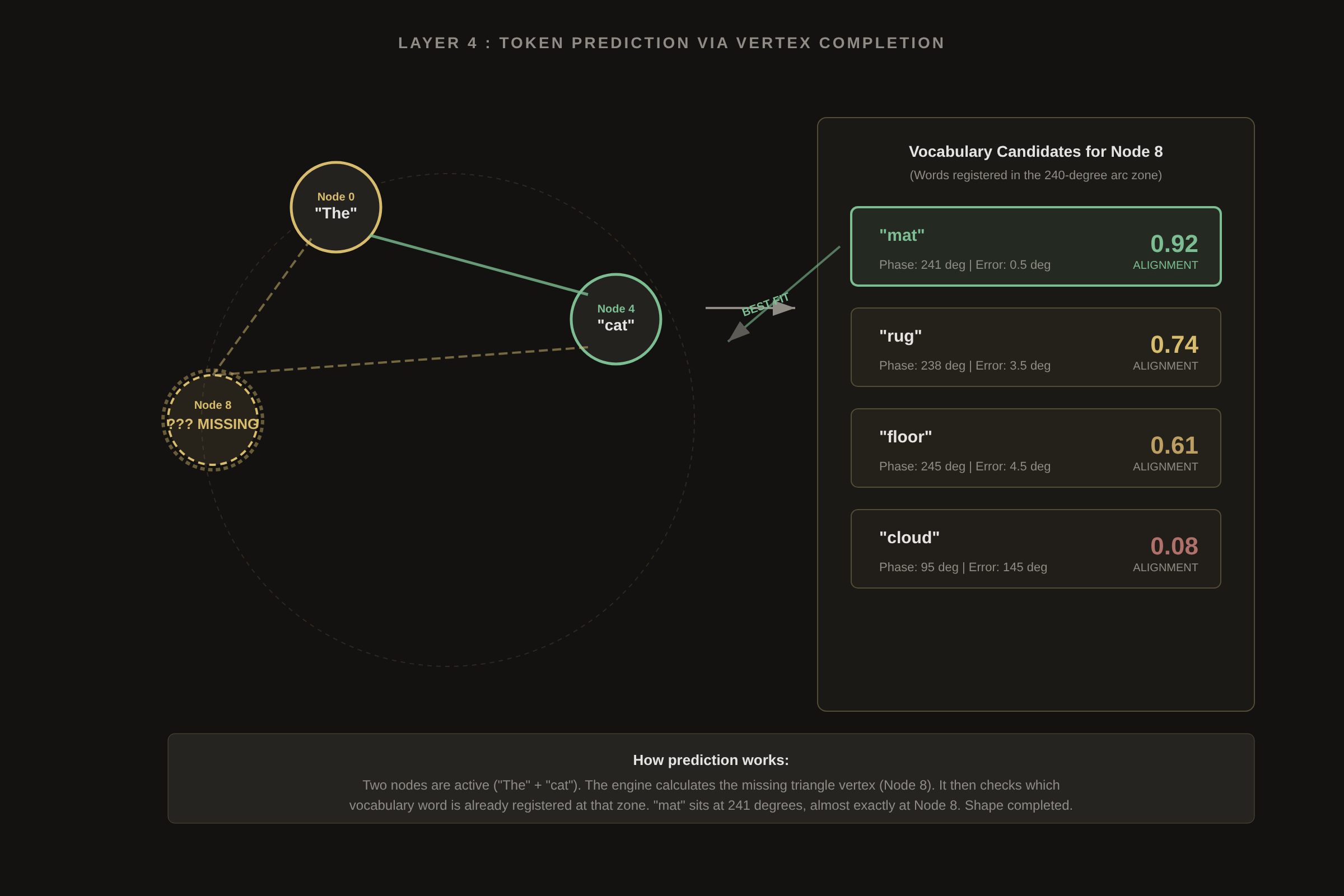
With two nodes active, the engine calculates the missing triangle vertex and evaluates vocabulary candidates by their angular proximity. “Mat” at 241 degrees is the closest fit.
Key insight: Token prediction is not a statistical guess. It is a geometric lookup. The engine knows where the next word must sit on the map, then checks which vocabulary word is already registered at that location. The word with the closest angular position wins.
Click "Next" to watch the engine complete a triangle vertex by vertex.
Two words are active: "The" (Node 0) and "cat" (Node 4). The engine asks: what triangle family do these belong to?
Why This Eliminates LLM Overhead
The Tobey Design Pattern Matching engine replaces the core computational machinery of a transformer with a fixed geometric structure. A standard LLM processes text through multiple layers of attention heads, each of which computes dot products between query and key vectors for every pair of tokens in the sequence. This means the computational cost scales quadratically with sequence length: a conversation of 100 tokens requires roughly 10,000 attention calculations per layer, and a conversation of 1,000 tokens requires roughly 1,000,000. The KV-cache that stores previous token representations grows linearly with the sequence, consuming ever more memory.
The Tobey engine eliminates the bulk of this overhead. There are no attention heads, no query-key-value projections, and no softmax distributions. The 144-lattice is a fixed 12-by-12 grid that never grows, regardless of how long the input or output becomes. Checking whether a pattern matches is a single bitwise AND operation against a template mask. Predicting the next token requires computing one modular arithmetic formula (to find the missing triangle vertex using the fixed 4-zone step) and then comparing angular positions of a bounded set of vocabulary candidates registered in that zone. Each individual operation is O(1) constant time. To be precise about memory: the engine does maintain an append-only log of discrete lattice snapshots so that multi-turn conversations retain context, but this log stores compact bit-arrays rather than high-dimensional floating-point vectors, making it orders of magnitude cheaper than a KV-cache.
The implications are significant for hardware implementation. Because the core operations are modular arithmetic, bitwise masking, and simple angular comparison, the entire engine can be implemented directly in digital logic gates on an FPGA or ASIC. There is no need for the floating-point matrix multiplication units that make GPU-based LLM inference so power-hungry. The original document describes Verilog implementations targeting AMD Xilinx DSP48E2 slices, with phase-locked loops for clock synchronization and hysteresis bands for noise suppression, all operating at the granularity of individual clock cycles.
| Dimension | Standard LLM (Transformer) | Tobey Geometric Engine |
|---|---|---|
| Next-token prediction | Attention matrix multiplication + softmax sampling | Triangle vertex calculation + angular lookup |
| Context memory | KV-cache grows linearly with sequence length | Fixed 144-cell lattice + append-only bit-array log |
| Pattern detection | Learned statistical patterns in weight matrices | Fixed geometric invariants (Mod-3 triangles, Mod-4 squares) |
| Computational cost | O(n²) attention, grows with sequence | O(1) per operation; lightweight discrete log for multi-turn |
| Hardware requirement | GPU with floating-point matrix units | FPGA with logic gates and registers |
The Tobey engine does not “trade away” expressive capability for efficiency. It ditches an inferior paradigm entirely. The geometry governs how generation occurs — not what knowledge the system can contain. All of the vocabulary mappings, coordinate rules, and relationship patterns encoded on the 12-zone ring and 144-lattice are built from vast datasets, domain taxonomies, and linguistic corpora. The knowledge capacity is fully retained; what is discarded is the brute-force statistical machinery that makes standard transformers so computationally wasteful. Where a transformer generates tokens by sampling dynamically from high-dimensional probability distributions — relying on massive KV-caches, unconstrained vector drift, and iterative search trees — the Tobey engine resolves output through deterministic topological shape-completion, filling in missing vertices and completing geometric structures based on fixed coordinate rules. A topologically driven architecture can generate highly complex, creative, and open-ended narratives, poetry, or reasoning chains provided the underlying semantic mapping and vertex prediction rules are rich enough to capture those dimensions. The constraint is purely structural — how tokens are selected and validated — not semantic or expressive.
As noted earlier, natural-language polysemy — words like “run,” “watch,” or “light” that shift between grammatical roles depending on context — is handled by a lightweight part-of-speech disambiguation pass before words enter the geometric pipeline, ensuring each word lands in the correct zone while preserving O(1) efficiency. This pre-lattice parsing step means the engine does not rely on statistical context to disambiguate meaning; it uses a deterministic structural check, keeping the entire pipeline from input to output free of probabilistic guessing.
The critical distinction: the Tobey engine is not a reduced subset of an LLM. It is a fundamentally different computational paradigm that retains full knowledge capacity while eliminating the probabilistic overhead that makes transformer-based systems unreliable in domains where failure is not an option.
Why Probabilistic AI Fails Where It Matters Most
The failure of current artificial intelligence systems to deliver reliably in mission-critical environments stems from a fundamental structural mismatch: probabilistic token sampling cannot satisfy deterministic requirements. This friction is nowhere more evident than in federal procurement, where compliance is governed by rigid mandates under the Federal Acquisition Regulation (FAR). The gap between what probabilistic models produce and what federal law demands explains why AI adoption in government frequently stalls, introduces unacceptable legal risk, or fails under audit scrutiny.
The Core Paradox: Statistical Guessing vs. Binary Accountability
Standard transformer-based LLMs operate by predicting the next token using high-dimensional probability distributions derived from training data. Given the same prompt twice, a probabilistic model can yield different outputs, drift into semantic hallucinations, or alter formatting. It answers questions based on statistical likelihood rather than logical proof. Federal regulations, contract clauses, and statutory frameworks are strictly binary: a requirement is either met or breached; a cost is allowable or unallowable under FAR Part 31; a clause is included or omitted. When an AI system is deployed to handle procurement analysis, contract writing, or compliance verification, its inherent statistical “fuzziness” clashes directly with the legal standard of deterministic accountability.
Four Failure Modes Under the FAR
1. The Explainability Deficit (FAR Part 15)
Federal source selections and contracting decisions must be fully transparent, rationalized, and capable of surviving protest scrutiny under the Government Accountability Office. If an AI tool influences an evaluation score or summarizes proposal compliance using opaque weights and probabilistic reasoning, contracting officers cannot explain how the output was derived. When the “black box” cannot show its work step-by-step, the entire procurement action becomes legally indefensible.
2. The TINA Trap (FAR Part 30 & 32)
Under the Truthful Cost or Pricing Data Act and Cost Accounting Standards, every cost element, pricing factor, and estimating assumption must be explicitly tracked and defended. Probabilistic AI tools that generate dynamic cost adjustments, token-level cost allocations, or automated pricing narratives introduce uncontrollable variance. If an estimator cannot prove the underlying arithmetic is deterministic and repeatable, the submission risks severe noncompliance findings and questioned costs.
3. Zero Tolerance for Hallucination
FAR contract administration requires exact compliance with standard clauses, domestic sourcing mandates such as the Buy American Act, and security protocols. A probabilistic model that “hallucinates” a clause citation, misinterprets a mandatory socioeconomic requirement, or omits a required regulatory provision creates immediate breach-of-contract exposure. In legal drafting, “close enough” is a liability.
4. Opaque Safety and Refusal Layers
Modern commercial AI models rely on heuristic safety filters and alignment layers that dynamically block or alter outputs based on proprietary corporate guidelines. Under federal contracting terms, systems cannot refuse to produce required data outputs or analyses based on arbitrary vendor discretion. Probabilistic safety guardrails frequently conflict with the mandatory, unyielding obligations of federal performance.
These are not edge cases or teething problems. They are structural incompatibilities. A system built on statistical approximation cannot be retrofitted to produce legally defensible, fully deterministic outputs. The only path forward is an architecture that is deterministic by design — where a given input always traverses the exact same logical path, and every step of the computation is traceable, reproducible, and auditable. The Tobey engine’s fixed geometric coordinates, closed-loop validation rules, and topological shape-completion provide exactly that: mathematical consistency required by federal law, built into the foundation rather than bolted on as an afterthought.
Competitive Displacement: Deterministic Wins
The competition between a deterministic topological paradigm and a probabilistic paradigm is not merely a technical disagreement over model parameters. It is an economic and structural shift driven by failure modes at scale. When probabilistic systems hit the hard limits of high-stakes, mission-critical environments, the demand for deterministic capability becomes absolute. That competitive displacement plays out across four distinct vectors.
1. The Economics of Failure vs. Zero Variance
Probabilistic models are statistical approximators. In low-stakes tasks like drafting marketing copy, an occasional hallucination or stylistic drift is tolerable. In high-stakes operational domains — legal compliance, financial auditing, procurement, safety-critical systems — statistical “near misses” translate directly into catastrophic financial, legal, or physical failures. Every hour spent human-reviewing, auditing, and correcting probabilistic outputs erodes the cost-efficiency promise of AI. A topological engine operating on fixed geometric coordinates and shape-completion guarantees zero semantic drift. Because generation is anchored to closed-loop validation rules rather than unconstrained token sampling, the output is mathematically reproducible and logically consistent. Enterprises and government agencies do not buy AI to “take a guess”; they buy systems that execute correctly 100% of the time under audit.
2. The Regulatory and Compliance Wall
As the FAR example demonstrates, probabilistic systems fundamentally struggle with statutory compliance. When an AI evaluation tool cannot explain how it derived a scoring decision or audited a cost breakdown without opaque vector weights, the entire procurement action becomes legally voidable under Government Accountability Office protest rules. Deterministic architectures bypass the “black box” audit deficit entirely. Because every node activation and geometric vertex completion maps to an explicit, traceable coordinate rule, the system produces a self-proving audit trail. In procurement, legal compliance, and regulated finance, a deterministic tool completely displaces a probabilistic model because it satisfies the non-negotiable legal requirement for explainability and deterministic accountability.
3. Scaling Bottlenecks: Brute-Force Bloat vs. O(1) Efficiency
To improve reliability, probabilistic systems must scale brute-force parameters: larger models, wider context windows, massive training clusters, and ballooning floating-point KV-caches. This creates an unsustainable trajectory of diminishing marginal returns, soaring inference costs, and latency bottlenecks. By abandoning iterative search trees and floating-point matrix multiplications for discrete lattice states and topological completion, the geometric paradigm achieves true O(1) execution speed with minimal memory overhead. It runs efficiently on constrained local hardware or deterministic FPGA/ASIC logic without requiring massive cloud-hosted GPU clusters. In real-time monitoring and high-throughput enterprise pipelines, speed and computational economy dictate market adoption.
4. From “Assistant” to Engine
The probabilistic paradigm is bottlenecked by its framing as a conversational “assistant” that requires constant human oversight. The market demand is rapidly shifting toward sovereign execution engines — systems that can autonomously manage workflows, codebases, and compliance rules without supervision. By ditching the inferior probabilistic paradigm in favor of deterministic topological execution, organizations replace stochastic guesswork with structural certainty, capturing the domains where failure is not an option. The Tobey engine represents exactly this transition: from a system that suggests to a system that executes.
The deterministic topological paradigm does not compete with probabilistic systems on their terms. It renders those terms obsolete. In every domain where output must be explainable, reproducible, auditable, and legally defensible, probabilistic sampling is not merely inferior — it is fundamentally incompatible with the requirements.
The map is fixed.
The shapes complete.
The search is over.
The Tobey engine replaces probabilistic search with geometric closure, turning language generation into a puzzle-solving process where every word has a place, and every sentence is a shape waiting to be completed.